Obesity is a chronic condition that can be treated more effectively today than ever before. This guide explains what obesity is, how it is treated, how modern GLP-1 medicines work, what kinds of pens exist and what it all means for your diet. It also shows how the tools on this site can help you with the numbers.
What obesity is
The World Health Organization (WHO) defines overweight in adults as a body mass index (BMI) of 25 or more and obesity as a BMI of 30 or more. BMI is calculated as weight in kilograms divided by height in metres squared. It is a quick indicative measure that is the same for men and women.
Obesity is not a matter of willpower or appearance. It is an excessive accumulation of body fat that may impair health, and a long-term condition influenced by genetics, hormones, sleep, stress, medicines, environment and lifestyle. That is why obesity is now approached as a disease, treated as systematically as high blood pressure or diabetes.
BMI also has its limits: it does not tell you how much of your weight is fat and how much is muscle. A more detailed picture comes from measuring body composition, for example by bioimpedance (InBody).
Why it matters
A higher amount of body fat raises the risk of many chronic diseases. WHO names in particular type 2 diabetes, cardiovascular disease, liver and kidney disease and some cancers. Obesity is also commonly linked to high blood pressure, abnormal blood fats, sleep apnoea, joint wear and polycystic ovary syndrome.
How obesity is treated
Modern care rests on three areas that complement each other. You do not have to pick just one; they are usually combined.
1. Lifestyle
Healthy, sufficiently rich food, regular movement, good sleep and care for mental wellbeing. Behavioural methods and nutrition counselling are often part of it. It is the foundation on which everything else stands.
2. Medicines
Products available today help with appetite and the feeling of fullness. The most important are GLP-1 medicines and their newer variants. A doctor prescribes and monitors them.
3. Surgery
Bariatric and metabolic surgery is intended for selected patients, mainly those with a higher BMI or serious related conditions. The decision always rests with the specialist team.
In December 2025 WHO issued a recommendation that places GLP-1 medicines as one component of multi-component long-term obesity care, alongside behavioural, nutritional and psychological measures. Medicines therefore do not replace diet or exercise; they make them easier to keep up.
Modern GLP-1 medicines and how they work
GLP-1 is a natural hormone from the family of incretins. It is made in the gut after a meal and sends the body several signals at once: it increases the feeling of fullness, slows the emptying of the stomach and, depending on blood sugar, supports the release of insulin. Natural GLP-1 is broken down in the body within minutes. The medicines therefore imitate it with substances that act far longer, so one injection a week or a day is enough.

In practice people describe less appetite, feeling full sooner and thinking less about food. That is exactly why it is so important to eat well and get enough protein: even with a smaller amount of food, the body must receive everything it needs (see nutrition during treatment).
Tirzepatide is a newer substance that acts not only on the receptor for GLP-1 but also on the receptor for another incretin, GIP. That is why it is called a dual agonist. Research on further substances that aim to act at even more targets is still under way in this field and their approval status changes quickly. You can always find the current status with the European Medicines Agency (EMA) and your national medicines authority.
Medicines and pens at a glance
Four products are most often talked about on our market. The data are taken from the summaries of product characteristics (SmPC), and each has a link to the official EMA document.
| Product | Active substance | Manufacturer | Administration | Pen |
|---|---|---|---|---|
| Ozempic | semaglutide | Novo Nordisk | once weekly | FlexTouch dial pen |
| Wegovy | semaglutide | Novo Nordisk | once weekly | FlexTouch dial pen |
| Saxenda | liraglutide | Novo Nordisk | once daily | pre-filled dial pen |
| Mounjaro | tirzepatide | Eli Lilly | once weekly | KwikPen with fixed doses |
What each is intended for is always set by the SmPC: Wegovy and Saxenda are intended for the treatment of overweight and obesity, Ozempic for type 2 diabetes, and Mounjaro is approved in the EU for type 2 diabetes and for weight management. A doctor prescribes them according to the patient's health.
Two kinds of pens
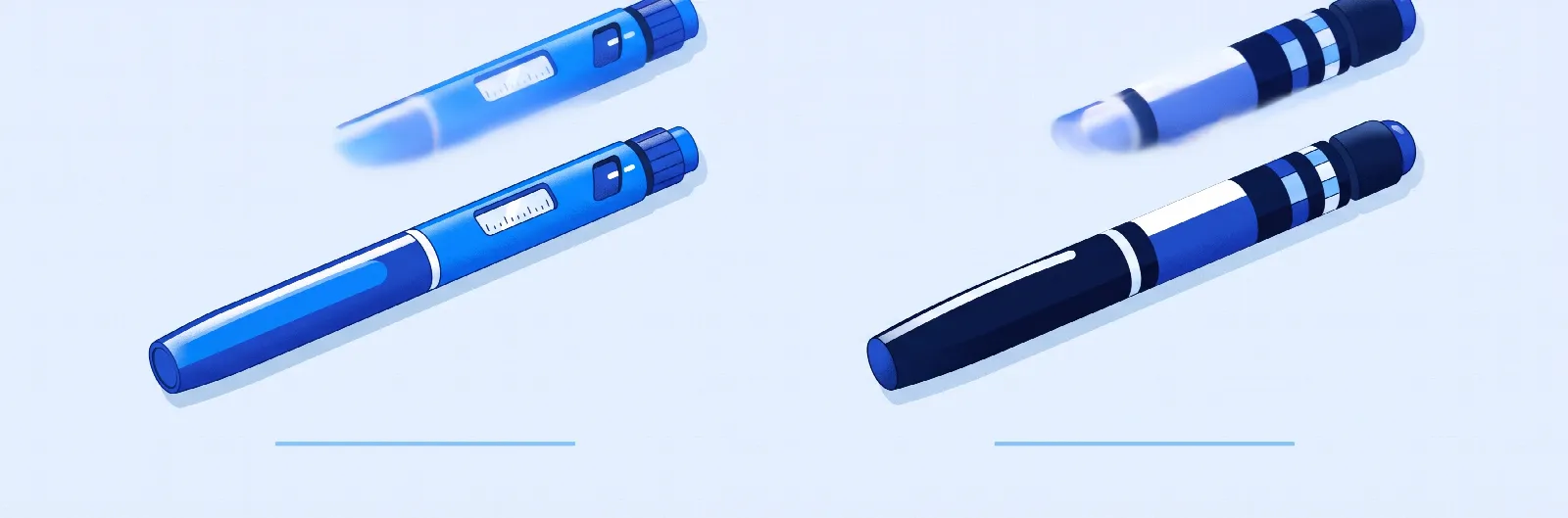
A dial pen (Ozempic, Wegovy, Saxenda) is set by turning the dose selector. The number in the window shows the dose in milligrams and there is no need to count clicks. A fixed-dose pen (Mounjaro KwikPen) comes in several strengths (2.5 to 15 mg) and each pen contains four weekly doses.
Detailed data on each strength, the sources and the date they were checked are in the Dosing section. If you need to convert a dose into pen clicks or into insulin syringe units, use the dose calculator.
What the studies show
The effectiveness of these products is described by large randomised clinical trials, in which the change in weight on treatment was compared with placebo, always together with lifestyle changes. The results are averages. Every person responds differently, so an individual approach is always needed.
| Study | Substance | Duration | Weight change | Placebo |
|---|---|---|---|---|
| SCALE (2015) | liraglutide 3 mg | 56 weeks | about −8% | about −2.6% |
| STEP 1 (2021) | semaglutide 2.4 mg | 68 weeks | −14.9% | −2.4% |
| SURMOUNT-1 (2022) | tirzepatide 5 / 10 / 15 mg | 72 weeks | −15.0 / −19.5 / −20.9% | −3.1% |
The benefit was not seen in weight alone. In the SELECT trial (more than 17,000 adults with overweight or obesity and established cardiovascular disease, without diabetes), semaglutide 2.4 mg reduced the risk of major cardiovascular events (cardiovascular death, non-fatal heart attack and stroke) by 20%: these events occurred in 6.5% of those treated and in 8.0% of those taking placebo.
Nutrition during treatment
When appetite drops, there is a risk of eating less than the body needs, mainly at the expense of protein. That is why during treatment it is recommended to watch for enough protein, fluids and good-quality food overall, so that weight loss affects mainly fat, not muscle. Regular resistance training also helps, if your doctor recommends it.
How large your daily intake of energy and protein should be for your height, weight and goal (loss, maintenance or gain) is calculated by the calorie calculator. The result is always a range, because an exact number would only be an illusion. After a few weeks you can compare the range with how your weight has actually changed in the calculator correction and fine-tune it. The equations, constants and sources are described in the method.

Practical tips that people on treatment often appreciate:
- smaller portions, but regularly, so meals are not skipped altogether
- protein with every meal (eggs, fish, lean meat, dairy, legumes)
- enough fluids through the day
- eating more slowly and noticing the first sign of fullness
- fibre and vegetables for digestion
Muscle and body composition
Weight is just one number. When losing weight, what matters is how much of it is fat and how much is muscle and other active mass. Two people of the same weight and height can have a completely different body composition.

You can measure body composition with a bioimpedance scale (for example InBody) at a surgery, health centre or studio. The measurement also gives you the value of lean (active) mass. The calorie calculator can use it instead of an estimate, which makes the calculation more precise. It also helps you see whether weight loss is going in the "right direction".
Starting treatment
GLP-1 medicines are usually started with a low dose that the doctor gradually increases. The body gets used to it and results appear over weeks to months. In the first weeks people most often notice changes in digestion, for example a feeling of fullness, nausea, a change in stools or less appetite for fatty and sweet foods. These usually ease with adjusting the diet and gradually raising the dose.
It helps if during this period you:
- eat smaller portions and avoid very fatty foods
- drink enough
- discuss anything that bothers you with your doctor, who can adjust the dose if needed
Detailed instructions, contraindications and all side effects can always be found in the package leaflet and in the SmPC of the particular product.
Safe purchasing and counterfeits
Interest in modern weight-loss medicines unfortunately also attracts sellers of counterfeits. Prescription medicines belong only in a pharmacy and on a doctor's prescription. If you come across a product from an unverified source, we recommend not using it. How to recognise a counterfeit and where to report a suspicion is summarised in the article How to recognise a counterfeit weight-loss medicine.
Tools on this site
Calorie calculator
An indicative range of daily energy and protein intake for loss, maintenance or gain. It can also use a measured lean mass.
Calculator correction
After a few weeks it compares the range with your actual weight and helps you fine-tune it.
Pen dosing
An overview of products by pen strength, links to the official SmPC and the date the data were checked.
The site is written to be simple and fast, works in Czech, Slovak and English and needs no registration. The data you enter are processed only in your browser. More articles about food, treatment and exercise are gradually being added to the blog.
Frequently asked questions
Is obesity really a disease?
Yes. WHO describes it as an excessive accumulation of body fat that may impair health, and counts it among the main risk factors for many chronic diseases. That is why it is treated systematically, like other long-term conditions.
Who is a suitable candidate for GLP-1 medicines?
Your doctor decides according to the SmPC and your health. The main studies included adults with a BMI of 30 or more, or a BMI of 27 or more with at least one weight-related condition. Specific indications and restrictions can always be found in the SmPC of the product.
How long is the treatment taken?
Obesity is a long-term condition, so treatment is usually long-term as well. The length and any changes to treatment are decided by your doctor according to your health and results.
Do I have to change my diet during treatment?
The medicines help with appetite, but the quality of food still matters. Enough protein, fluids and a varied diet help keep muscle and wellbeing. The calorie calculator works out an indicative intake.
Why does the calculator show a range and not one number?
The real energy need differs from person to person and depends on sleep, movement, hormones and body composition. One exact number would be misleading. A range is more honest and can be fine-tuned over time according to your actual weight.
What is lean (active) mass?
It is the weight of the body without fat, that is muscle, bones, organs and water. You can measure it by bioimpedance, for example on an InBody device. The calorie calculator can use it instead of an estimate, which makes the calculation more precise.
Sources
The data in this guide were checked on 9 Nov 2026.
- WHO: Obesity and overweight (fact sheet)
- Pi-Sunyer X. et al. SCALE: liraglutide 3.0 mg. N Engl J Med 2015;373:11–22
- Wilding JPH et al. STEP 1: semaglutide 2.4 mg. N Engl J Med 2021;384:989–1002
- Jastreboff AM et al. SURMOUNT-1: tirzepatide. N Engl J Med 2022;387:205–216
- Lincoff AM et al. SELECT: semaglutide and cardiovascular events. N Engl J Med 2023;389:2221–2232
- SmPC Ozempic (EMA)
- SmPC Wegovy (EMA)
- SmPC Saxenda (EMA)
- SmPC Mounjaro (EMA)